
"mechanical harvesting"
1000 article(s) found

Coffee picking process Video description of flavor and taste introduction of varieties
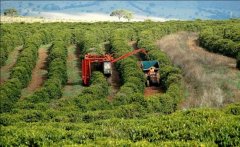
The Coffee picking process Video description of taste and flavor it has been calculated that the cost of harvesting a plantation or farm is half the total cost of the year. In Brazil, people have tried many times to use mechanical picking to reduce these costs. The machine shakes branches across the coffee tree so that the berries that have become loose due to ripeness will fall.

A brief introduction to the treatment method of grinding degree and baking degree of half-sun red bourbon El Salvador Himalaya coffee
Salvadoran coffee inherits the mild quality of Sino-American coffee, which is soft, slightly sour and has a beautiful sweetness. At the same time, it also has its own characteristics: the aromatic taste is slightly sour and very soft; it is pure and has no miscellaneous flavor, and the taste balance is excellent; the smooth feeling like cream chocolate is impressive; the dense feeling of coffee in the mouth gives the coffee a deep and long taste.
Geo-climatic production process of coffee in Rwanda
Maraba Coffee, the geographic and climatic editor, is grown in southern Rwanda, about 12km (7 miles) from the city of Butare and 150km (93 miles) from the capital, Gejali. The plan began in the Malaba area of Butare province, but was taken over by a local government organization in 2006, which is now part of the Huye district of the southern province. Due to its proximity to the East African Rift Valley and Neuenweisen,

Geo-climatic production process of coffee in Rwanda
Malaba Coffee grows in southern Rwanda, about 12 kilometers (7 miles) from the city of Butare and 150 kilometers (93 miles) from the capital, Gejali. The plan began in the Malaba area of Butare province, but was taken over by a local government organization in 2006, which is now part of the Huye district of the southern province. Due to its proximity to the East African Rift Valley and the Neuenway Forest Mountains, this area has many topography.

Malaba coffee grown in southern Rwanda Lutechiro, Western Province
Maraba coffee is grown in southern Rwanda, about 12 km (7 mi) from Butare and 150 km (93 mi) from the capital, Gigali. The project began in the Malaba area of Butare province, but was succeeded by local government organizations in 2006, and the area is now part of the Huye region of Southern province. Due to its proximity to the Great Rift Valley and the Nunwe Forest Mountains, the terrain of this zone

How to treat coffee beans Starbucks caramel macchiato
Brazilian semi-sun-natural pectin removal: Brazil used to use the sun method in the past, the quality is very poor, so that Brazil Yu is synonymous with medium and low quality. However, in order to improve the quality and reverse the image of the world's largest coffee producing country, the quality revolution was carried out in the 1990s, and the semi-sun method, which is unique in the world, was vigorously promoted. Brazilian coffee fields are endless, mostly harvested mechanically to meet the needs of

Malaba Coffee from Coffee producing areas in Southern Rwanda
Grows in southern Rwanda, about 12 km (7 miles) from the city of Butare and 150 km (93 miles) from the capital, Gejali. The plan began in the Malaba area of Butare province, but was taken over by a local government organization in 2006, which is now part of the Huye district of the southern province. Due to its proximity to the East African Rift Valley and the Neuenway Forest Mountains, the terrain is sloping and steep.

Taste of Brazilian Coffee Flavor Manor area introduces Brazilian boutique coffee beans
As the largest coffee producer in the country, Brazil supplies commercial beans and fine beans for the global coffee market. Instant coffee is also a critical component of coffee production in Brazil. Western coffee grows mostly at the height of 2000-3000 feet feet, about 500-100m. There are also heights up to 4000 feet, about 1200 m. However, absolutely pay other East Africa, Central and South America need manufacturing countries, easily 5000 feet

Taste characteristics of Coffee Flavor description in Fazenda Paie Filho Manor, COE, Brazil
With the promotion of specialty coffee in the region, in 2012, the coffee producer decided to rent a piece of land from one of his father-in-law's nephews to specialize in the production of specialty coffee. Since then, the family has been pursuing quality.
Brazilian half-sun natural pectin removal method volcano treatment
Brazil used to use the method of tanning in the past, and there was a big difference in quality, which made Brazil Chongqing synonymous with low-to-middle quality. However, in order to improve its quality and reverse its image, the world's largest coffee producer carried out a quality revolution in the 1990s and vigorously promoted the global half-sun method. Brazilian coffee fields are endless and are mostly harvested mechanically in order to meet the economic benefits. When 75% of the coffee fruit in the coffee garden
The characteristics and roasting methods of Kenyan coffee
Following Cafe Review (official Wechat account vdailycom) found that Kenyan Coffee is one of its favorite products that everyone in the coffee industry thinks is Kenyan Coffee, which has excellent and satisfying aroma, well-balanced acidity, well-balanced granules and excellent fruit taste. Kenyan coffee grade depends on the size of coffee beans.

Southern part of Malaba Coffee production area, a coffee variety from Rwanda
Malaba Coffee grows in southern Rwanda, about 12 kilometers (7 miles) from the city of Butare and 150 kilometers (93 miles) from the capital, Gejali. The plan began in the Malaba area of Butare province, but was taken over by a local government organization in 2006, which is now part of the Huye district of the southern province. Due to its proximity to the East African Rift Valley and the Neuenway Forest Mountains, the terrain

The technological process of coffee bean processing and roasting the production process mode of instant coffee processing
Coffee making process-Coffee processing plant process first, peeling: the peel and most of the pulp are removed by mechanical means. Second, fermentation third, drying fourth, roasting: raw coffee beans can release the special aroma of coffee through roasting. Each coffee bean contains its aroma, sour taste, sweetness and bitterness. How to release it incisively and vividly is to watch its roasting.
Harvesting of coffee beans
Every winter (dry season) is the harvest period of coffee beans, coffee trees after three to four years of growth, gradually mature, began to bear fruit, fruit next to the branches arranged in a string or cluster. Coffee beans wrapped in red skin inside, as soon as red on

Coffee tanning method
Sun-dried beans have a complete natural mellow flavor, gentle fragrance and more gum; washing laws have a good mellow taste, a high degree of fragrance and active sour taste.

Introduction to the treatment of raw coffee beans-tanning method
Sun treatment will first identify sunken beans in the sink, that is, ripe or half-ripe beans are spread in the drying farm for natural drying. The specific time depends on the local climatic conditions, which usually takes two to four weeks. When the moisture of the coffee bean is reduced to 12%, then use a sheller to grind off the hard pulp and silver skin. The requirement of the sun treatment on the climate is very high.
Introduction to the treatment of raw coffee beans in the sun
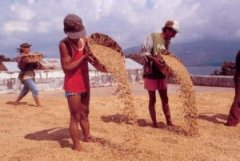
Sun treatment will first identify sunken beans in the sink, that is, ripe or half-ripe beans are spread in the drying farm for natural drying. The specific time depends on the local climatic conditions, which usually takes two to four weeks. When the moisture of the coffee bean is reduced to 12%, then use a sheller to grind off the hard pulp and silver skin. The requirement of the sun treatment on the climate is very high.

Washing characteristics of evenly dried Salvadoran coffee beans introduction to the taste and quality of manor flavor description treatment
El Salvador coffee washed coffee fields are endless, mostly harvested mechanically, in order to meet the economic benefits. When 75% of the coffee fruit in the coffee garden turns red, mechanical harvesting is started, followed by the same pre-washing operation, which is moved into the sink to remove floating beans, sift out the sunken beans, and then use a large pulp screening machine to dig out the pulp and remove the pods covered with pectin. The next stage is related to the water washing method.

Introduction of Lutesilo producing area in the western province of Malaba Coffee Chimel Manor, Rwanda
Malaba Coffee grows in southern Rwanda, about 12 kilometers (7 miles) from the city of Butare and 150 kilometers (93 miles) from the capital, Gejali. The plan began in the Malaba area of Butare province, but was taken over by a local government organization in 2006, which is now part of the Huye district of the southern province. Due to its proximity to the East African Rift Valley and the Neuenway Forest Mountains, the terrain
Rwandan coffee flavor aroma, Rwandan coffee bean output
Pay attention to the coffee review (Weixin Official Accounts vdailycom ) and find that the taste of Rwandan coffee is described as grassy aroma with tropical climate characteristics. In addition to the fruity sweetness of this coffee, it can also make people taste refreshing, clear and fresh. Bourbon coffee grown in Rwanda is amazing for its fruity sweetness